


.svg)
.svg)


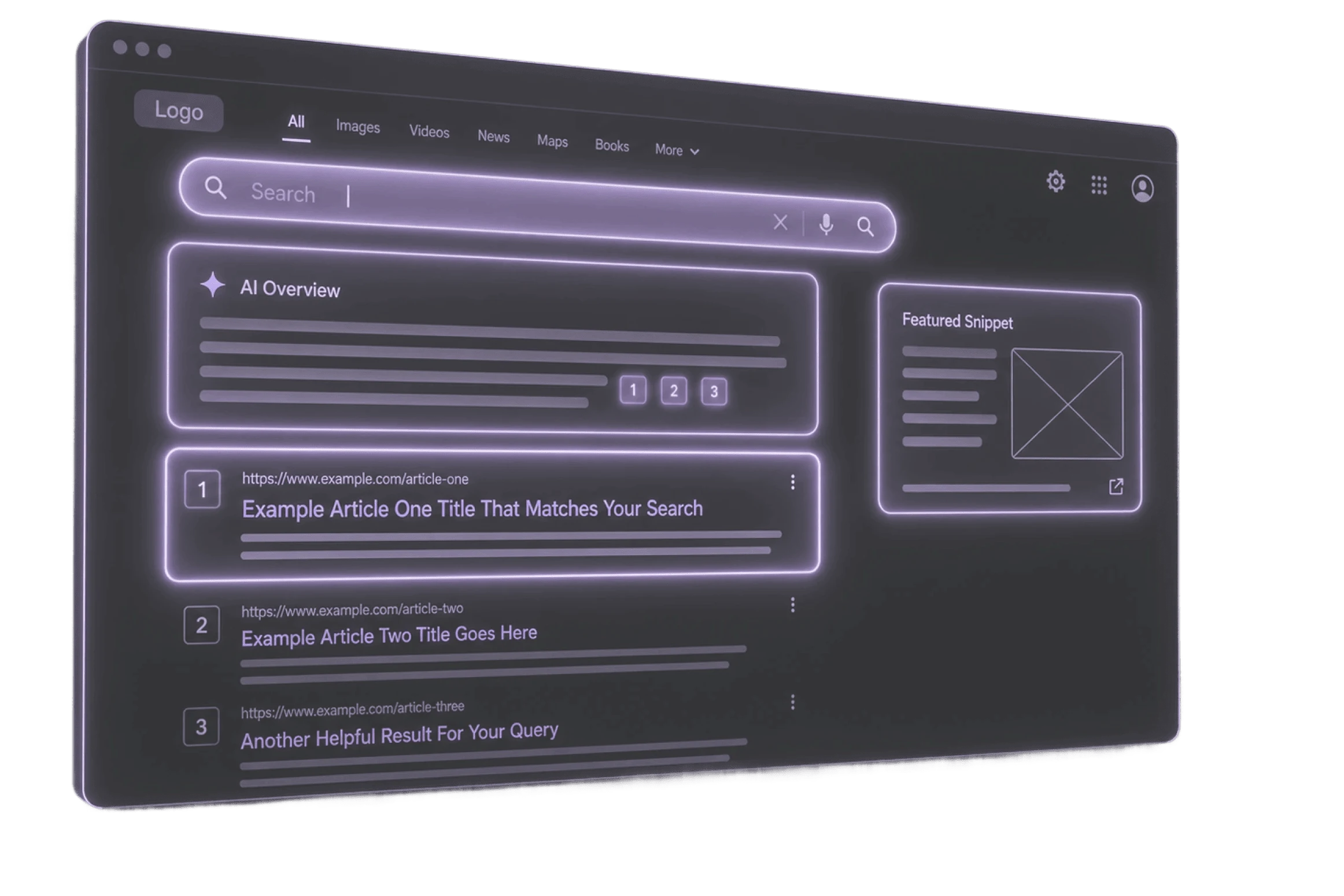
Google ranks the sources it trusts. AI tools cite them. Strategize well and you tend to get both.

.svg)
Search Services

Search Optimization
When you ask Claude to recommend a vendor, only a handful of names come up. Not millions. The competition for AI visibility is more concentrated, and the cost of being absent is higher.
GEO and LLMO cover the signals AI tools draw from when forming answers.

Technical SEO
Search starts with a foundation that works. Site speed, crawlability, schema, and Core Web Vitals determine whether good content gets found.
A full audit covers every layer, including migrations that protect ranking history. It stays solid as the site grows.

Content Strategy
Ranking well starts with understanding what someone wants when they search, which is often different from the keyword itself.
Real depth on the right topics, structured to rank on Google and get cited in AI answers, earns results that compound over time.

Local & International SEO
A local bakery and a software company expanding across borders have different problems. One needs Map Pack visibility. The other needs localized content and a setup that tells Google which version belongs where.
The approach fits the problem.
How It Works

Audit
Before any work is planned, there is a conversation about where the business stands, where it is going, and who it is trying to reach. From there, technical health, content gaps, the competitive landscape, and AI visibility are all reviewed. That covers what is working and where the real opportunities are.

Strategy
The audit becomes a prioritized roadmap. What to address first, what comes later, and what to leave alone, all ordered by impact and effort. Timelines and expected outcomes are carefully calculated before work starts.

Execution
Technical fixes go in first, then content, then authority signals. Each stage builds on the one before it, and the work is done in-house. Nothing important gets handed off.

Iteration
Search changes. Algorithms update. AI tools shift what they cite and how. After each month, a report covers what changed, what moved, and what comes next. The strategy adjusts when it needs to. The work does not stop when the site goes live.
Rankings that hold. Traffic that converts. A clear record of what the work is doing.
Organic growth
Search visibility that builds month over month, across Google search, AI answers, and local results.
Technical health
A site that loads fast, crawls cleanly, and stays in good shape as the site grows.
Content that compounds
Pages that keep earning rankings and citations long after they go live.
AI visibility - GEO and LLMO
Cited in AI answers before a buyer ever opens a search result page.
Clear reporting
Easy to read monthly reports that show what moved, what changed, and what comes next.
Who this is for
Good fit
- You have a product or service with real demand and a timeline longer than a quarter.
- You want to understand what is driving your visibility, not just receive a report.
- You are open to sharing business context, because that is what a useful strategy is built on.
- You see organic search as something worth building, not a shortcut to avoid paid ads.

Not a fit
- You need leads this week.
- Your offer or positioning is still being worked out.
- You want execution without questions or input from your side.

Frequently Asked Questions

Technical fixes can go in within a few weeks. Rankings take longer, usually several months before a clear trend appears.SEO builds on itself over time. The early work lays the foundation. What happens after that is what moves the numbers.
More than ever, actually. Tools like Google AI Overviews, ChatGPT, and Perplexity all draw from the same pool of trusted, well-organised sources. The work that gets a page ranking on Google is largely the same work that gets it cited by AI tools. Do one well, and you tend to get both.
Rankings, traffic, and where it's coming from. But also what changed, what the next priority is, and why. Written in plain English. Clear, simple, scannable.
Both, and in the right order. Technical health comes first because a well-written page that cannot be crawled does not rank. Content strategy follows, built around what people are searching for and the topics that matter in a given space. Authority signals come after that.
That's worth looking at carefully before doing anything else. The audit looks at what was done, what wasn't, and what the site looks like now. Sometimes the work was fine but the timeline was too short. Sometimes the strategy missed the mark. Either way, the answer shapes what comes next.
Ideally, yes. Direct access lets us ship fixes and improvements quickly, since most SEO work involves editing pages, redirects, and site settings.
If that's not an option, we can still do the work and document every fix clearly for your team to apply.
Either way, every change is logged, and nothing significant goes live without your sign-off.
Algorithm updates happen. Sites built on strong technical foundations and real, useful content tend to recover faster and hold their ground better than those built on shortcuts. When an update hits, the work is to figure out what changed and adjust. Monthly reporting means nothing goes unnoticed.